


How Applied Food Science Converts Safety Requirements Into Commercial Differentiation
By Radwa El Amir
The Food Producer's Trilemma
Food manufacturers in Egypt and the broader MENA region face a simultaneously commercial and scientific challenge: they must produce products that are safe (microbiological stability, allergen control, pathogen elimination), long-shelf-life (cost-effective distribution, export capability, reduced waste), and innovative (differentiated in increasingly competitive markets). The conventional assumption is that optimizing for one of these dimensions requires trade-offs against the others — that safer means less shelf-stable, that longer shelf life requires preservatives that compromise clean-label positioning, that innovation disrupts established safety processes. This assumption is becoming a strategic liability.
MENA food markets are among the fastest-growing globally, with projected food and beverage market size reaching USD 560 billion by 2030. Egypt alone, with its 105+ million population and significant food manufacturing base, is positioned to be a regional food production hub — but only if its manufacturers can meet GCC import standards, EU food safety specifications, and clean-label consumer demands simultaneously.
The Science of Shelf Life: Beyond Preservatives
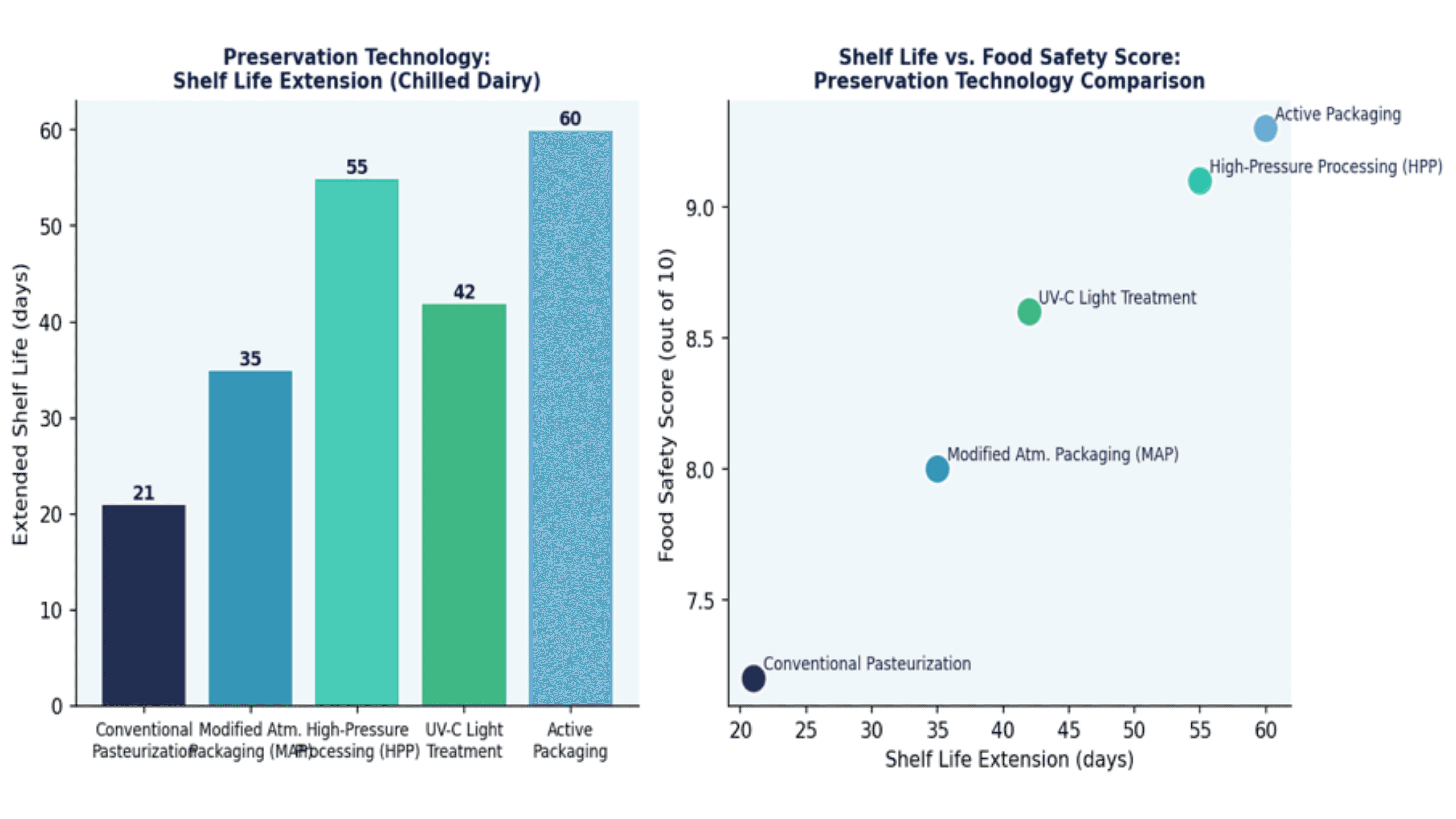
Figure 1. Left — Preservation Technology: Shelf Life Extension by Method (chilled dairy, days). Right — Shelf Life vs. Food Safety Score: Preservation Technology Comparison.
Traditional shelf life extension in MENA food manufacturing has relied heavily on thermal processing (pasteurization, sterilization) and chemical preservatives. These approaches are well-understood, cost-effective, and compatible with existing infrastructure — but they carry commercial limitations in an era of clean-label preferences, functional food demand, and premium market positioning.
Modern food preservation science offers a portfolio of alternatives, each with a different performance-cost-consumer acceptability profile. The comparative analysis (Figure 1) reveals that non-thermal technologies — High-Pressure Processing (HPP) and Modified Atmosphere Packaging (MAP) — deliver significantly extended shelf life (55 days and 35 days respectively versus 21 days for conventional pasteurization for chilled dairy products) while achieving higher food safety scores.
• High-Pressure Processing (HPP): Applied at 400–600 MPa for 1–6 minutes, HPP inactivates pathogens including Listeria monocytogenes, Salmonella, and E. coli without heat-induced chemical changes. The cold pasteurization result: products that retain fresh taste, color, and nutritional profile while achieving a safety level equivalent to thermal pasteurization. Average shelf life extension for chilled dairy: 55+ days. Capital cost: USD 1–3M per HPP unit, with co-packing models available for SMEs.
• Modified Atmosphere Packaging (MAP): Replacing the oxygen in product packaging with CO₂ and N₂ mixtures inhibits aerobic microbial growth and lipid oxidation. MAP is gas-specific and product-specific — getting the atmosphere composition right requires understanding the specific microbial flora and oxidation chemistry of each product. When correctly engineered, MAP extends shelf life to 35 days for fresh dairy without any preservative addition.
• Active Packaging: Incorporating antimicrobial agents (nisin, natamycin, silver ion systems) or oxygen scavengers directly into the packaging material creates a distributed, sustained preservation mechanism. Active packaging extending shelf life to 60 days represents the current state of the art for chilled products and is commercially available from suppliers in Europe and Asia.
Food Safety as Regulatory Architecture
Food safety is not merely a microbiological challenge — it is a regulatory architecture challenge. Accessing GCC food markets requires compliance with SASO (Saudi Arabia), ESMA (UAE), or QSMO (Qatar) standards, each with product-specific requirements for labeling, allergen declaration, additive permissions, and testing documentation. Accessing EU markets requires compliance with Regulation (EC) No 178/2002 (General Food Law), the Food Information to Consumers Regulation, and sector-specific regulations for dairy, meat, or processed foods.
For Egyptian food manufacturers with export ambitions, building the regulatory compliance architecture — HACCP system design, specification documentation, third-party testing relationships with accredited GCC or EU laboratories, and internal allergen control systems — is a prerequisite for market access that cannot be deferred to the pre-export stage. It must be built into the product development and production process from the beginning.
Innovation and Safety: Not Opposites
The most commercially successful food innovations of the past decade are also the safest: clean-label products with minimal ingredient lists, functional foods with defined health benefits and rigorous dosage control, and allergen-free products with documented free-from manufacturing protocols. The innovation and the safety framework are mutually reinforcing, not in tension. The food manufacturers who understand this — who use science to innovate and science to ensure safety — are the ones capturing premium market positions in MENA and export markets simultaneously.
Key Takeaways
• Non-thermal preservation technologies (HPP, MAP, active packaging) extend shelf life 2–3x versus conventional pasteurization while improving food safety scores and supporting clean-label positioning.
• GCC and EU market access requires regulatory architecture — HACCP, allergen control, documented testing — that must be built into product development, not retrofitted for export.
• MENA food and beverage markets are projected to reach USD 560B by 2030 — Egyptian manufacturers with export-quality safety and shelf life systems are positioned to capture a significant share.
• The most commercially successful food innovations are also the safest — scientific rigor in safety design is the enabler of premium market positioning, not its constraint.
References
[1] Balasubramaniam, V.M., Martínez-Monteagudo, S.I., & Gupta, R. (2015). Principles and Application of High-Pressure–Based Technologies in the Food Industry. Annual Review of Food Science and Technology, 6, 435–462.
[2] European Parliament. (2002). Regulation (EC) No 178/2002 — General Principles and Requirements of Food Law. Official Journal of the European Union.
[3] Codex Alimentarius Commission. (2020). General Principles of Food Hygiene (CXC 1-1969, Rev. 2020). Rome: FAO/WHO.
[4] Statista Research Department. (2024). MENA Food and Beverage Market Forecast 2024–2030. Hamburg: Statista.
[5] Yam, K.L., Takhistov, P.T., & Miltz, J. (2005). Intelligent Packaging: Concepts and Applications. Journal of Food Science, 70(1), R1–R10.
Creative gold for your inbox
Get the latest articles and news delivered straight to your inbox. Subscribe now to stay informed.